

In April, Google’s most volatile core update in years reshaped rankings at scale, while new data confirmed AI’s rapid growth alongside – not instead of – traditional search. At the same time, AI models became more autonomous, agentic search matured into a clear optimisation discipline, and platforms tightened control over commerce and visibility. Meanwhile, social platforms strengthened their role as search engines, and paid media moved further into closed, AI-driven ecosystems – from Apple’s expansion into ads to ChatGPT’s shift toward performance bidding. Across every channel, the direction is clear: fewer open journeys, more platform control, and rising pressure on brands to be selected, not just found.
Here’s what changed across Google, AI, Agentic, Social, and Paid and what it all means for brands navigating the next phase of search.
Google Search
Google’s latest core update reshuffled rankings at scale, while new insights from Search Central confirmed what actually drives visibility in an AI-heavy environment: quality, authority, and direct ownership of topics.
March 2026 Core Update drives major ranking volatility
Nearly 80% of top-three rankings shifted following the March 2026 Core Update, making it one of the most disruptive in recent years. Aggregators and broad publishers were hit hardest, while brands and authoritative destination sites gained visibility. Notably, one in four top-10 results dropped out of the top 100 entirely.
Why it matters: Google is clearly favouring direct, authoritative sources over intermediaries. Content that sits in the middle of a topic is losing ground, while brands that own and demonstrate expertise are gaining visibility. This reinforces the need for depth, credibility, and clear topical authority to remain competitive.
Google Search remains dominant despite AI growth
Despite rapid AI adoption, Google Search still remains largely dominant, with around 80 billion monthly searches compared to 45 billion across AI platforms. Data also shows that usage of AI has stabilised worldwide since July 2025. The rise of AI is expanding the overall search landscape rather than replacing traditional search behaviour.
Why it matters: The assumption that AI will replace search is proving inaccurate. Instead, search is becoming expansionary, with multiple channels coexisting and growing. For brands, this means continuing to invest in Google while adapting to new AI-driven behaviours, rather than shifting focus entirely.
Google Search Central Live reveals 2026 priorities
Insights from Google Search Central Live Toronto highlighted key shifts: indexing is increasingly tied to content quality, blocking AI usage comes with trade-offs, and structured data opportunities, particularly in e-commerce, are expanding. It also confirmed that tactics like llms.txt offer no SEO benefit.
Why it matters: Google is raising the bar for what gets indexed and surfaced, especially as AI accelerates content production. Teams need to prioritise quality over scale, understand the trade-offs of blocking AI usage, and take advantage of structured data to improve visibility. The focus is shifting from technical workarounds to content credibility and clarity.
AI Search
April showed AI moving in two directions at once: more powerful and autonomous models are emerging, while some early hype cycles are starting to correct. AI usage continues to grow rapidly, but the bigger story is how search behaviour is expanding across both traditional search and AI-led journeys.
OpenAI announces GPT-5.5, its most autonomous model yet
OpenAI unveiled GPT-5.5 on April 23rd, positioning it as its most autonomous model to date. The model is designed to handle unclear problems with less human guidance, supporting more advanced work across coding, data analysis, online research and document creation. It is now available to paid ChatGPT users, with API access to follow.
Why it matters: This signals a shift from AI as a reactive tool to AI as an outcome-driven system. For search and content teams, that means more capable agents that can research, brief, analyse and execute workflows with less manual input. The gap between brands using AI strategically and those still experimenting is likely to widen.
OpenAI closes Sora and cancels Disney deal
OpenAI has shut down Sora, its AI video-generation app, less than two years after launch. Despite early excitement around high-quality prompt-based video, questions remained over monetisation and commercial scalability. OpenAI is now expected to focus more heavily on other areas, including robotics and real-world task automation.
Why it matters: This is a reminder that not every high-profile AI launch becomes a long-term product. For marketers, the lesson is to separate novelty from utility. AI video still has potential, but brands should focus investment on tools with clear workflow value and measurable output, rather than chasing every shiny launch.
Google AI Mode adds side-by-side web browsing
Google updated AI Mode on April 16th, allowing Chrome desktop users to open websites directly alongside AI-powered search results. Users can now browse, compare and ask follow-up questions in one view, while also pulling existing tabs into searches for added context.
Why it matters: Google is keeping users inside its ecosystem for longer. The traditional click-and-visit journey is being compressed into a more integrated AI browsing experience. Being cited inside AI Mode is becoming increasingly important, because visibility now starts before a user reaches the website.
Agentic Search
AI visibility in April is becoming less about ranking links and more about being retrieved, trusted and selected by autonomous systems. As AI agents interpret content across the wider web, brands need to optimise for how machines understand reputation, relevance and authority, not just how pages rank.
Agentic Search Optimisation reshapes brand visibility
A new framework, Agentic Search Optimisation (ASO), is emerging as AI systems like ChatGPT, Google AI Mode and Perplexity retrieve and evaluate information without always sending users to websites. TechRadar reports that AI-driven search traffic grew from under 2% to more than 9% of desktop search between 2024 and 2025, while traditional Google searches per user declined by nearly 20%.
Why it matters: AI reads far beyond your website, including media coverage, reviews, Reddit threads, YouTube videos and partner mentions. What others say about your brand now shapes whether AI trusts and includes you. Brand demand, original data-rich content and consistent signals across channels are becoming critical, while generic, safe content risks becoming invisible.
The Fan-Out Effect: what happens between a query and a citation
AirOps analysed 16,851 queries and 353,799 pages across ChatGPT’s retrieval pipeline to understand what drives AI citations. Retrieval rank was the strongest signal: position one had a 58% citation rate, compared with 14% at position 10. Focused pages covering 26–50% of fan-out subtopics outperformed comprehensive guides, while domain authority showed no positive correlation.
Why it matters: AI optimisation starts with being retrievable, not just authoritative. Traditional signals like backlinks and domain authority appear less predictive than retrieval position and query alignment. The “ultimate guide” approach may underperform when relevance is diluted, making focused, well-structured pages with clear headings, schema and concise depth more valuable.
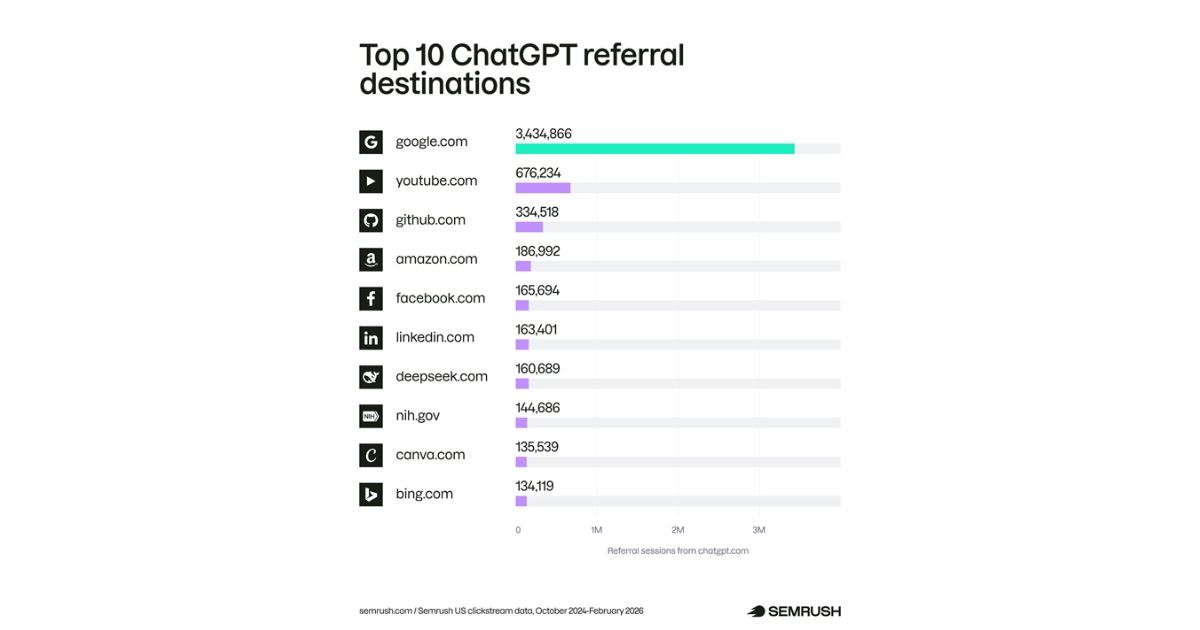
One in five ChatGPT clicks go to Google
Semrush analysed more than 1 billion lines of US clickstream data and found that Google captures 21.6% of all ChatGPT referral traffic, with the top 10 domains taking more than 30% of referrals. ChatGPT triggered web search on only 34.5% of queries, down from 46% in late 2024, while referral traffic grew 206% year-on-year.
Why it matters: ChatGPT visibility does not automatically translate into meaningful traffic. Referral distribution is highly concentrated, and many prompts never trigger web search at all. Brands should recalibrate expectations around AEO: being cited matters for influence, but it may not deliver clicks at scale – and Google remains a major beneficiary of ChatGPT’s outbound traffic.
Social Search
April showed how quickly social has moved from a support channel to a primary search environment. Platforms are doubling down on search functionality, while content created on social is increasingly feeding both platform discovery and AI-generated answers.
TikTok prioritises search with Creator Search Insights
TikTok has launched Creator Search Insights on desktop, giving creators visibility into what their audiences are actively searching for. The update reinforces TikTok’s evolution from content feed to search engine, with metadata, captions and on-screen text playing a bigger role in content discovery.
Why it matters: TikTok search is now a core discovery channel, particularly for younger audiences. Content needs to be created with search intent in mind, not just engagement. Captions, keywords and on-screen text are becoming critical for visibility, turning every post into a searchable asset.
LinkedIn becomes a top cited source in AI search
New studies show LinkedIn is now one of the most cited platforms across AI search tools, with tens of thousands of LinkedIn URLs appearing in AI-generated responses. Citation frequency has more than doubled in recent months.
Why it matters: AI systems are increasingly pulling from professional and expert-led content, not just traditional web pages. LinkedIn posts, articles and commentary are now acting as AI-discoverable assets. Brands that are not publishing consistently on LinkedIn risk missing visibility in both AI and search.
Social becomes the primary search engine for under-35s
New data shows users are increasingly turning to platforms like TikTok and Instagram to search for products, recommendations and information. On Instagram alone, 83% of users now search for new brands within the app.
Why it matters: Search and social are no longer separate behaviours. Discovery now happens directly within feeds, which also act as search environments. Brands need to build content that performs both as scrollable content and as searchable content to remain visible.
Paid Search
April showed paid media moving further into platform-controlled ecosystems, with AI, commerce and advertising becoming more tightly integrated. From Apple’s expansion into ads to Google’s automation push and ChatGPT’s evolving ad model, the direction is clear: more closed-loop, AI-driven performance environments.
Apple expands deeper into advertising
Apple is scaling its advertising business beyond the App Store, with new placements in Maps and tools aimed at small and midsize businesses. While most of its revenue still comes from app ads, these moves signal a broader push into performance and local media budgets.
Why it matters: Apple is positioning itself as a stronger player in performance media, particularly for local and SMB advertisers. This reflects a wider shift toward closed-loop ecosystems where discovery, ad exposure and purchase all happen within the same platform. As more platforms move in this direction, reliance on external websites continues to decrease.
Google migrates Dynamic Search Ads to AI Max
Google is moving Dynamic Search Ads into its AI-powered AI Max platform, which uses machine learning to predict intent, generate ad copy and select landing pages. The transition is underway, with full automation expected by September.
Why it matters: This marks a shift away from keyword-led campaigns toward AI-driven intent targeting. Manual control is reducing, while performance depends more on data quality, creative and signals. Paid search is becoming more conversational and automated, aligning with how users now interact with AI-led search.
OpenAI introduces CPC bidding for ChatGPT ads
ChatGPT’s ads platform is now testing CPC bidding ($3–$5 per click) for select advertisers, moving beyond its initial CPM-only model. Pricing has dropped, and new self-serve tools are being introduced.
Why it matters: CPC bidding makes ChatGPT ads viable for performance marketers, not just brand campaigns. It allows clearer comparison with Google and Meta, accelerating adoption. This signals ChatGPT’s transition into a measurable, conversion-driven media channel rather than experimental inventory.
TikTok rolls out more immersive ad formats
TikTok is launching new high-impact formats, including Logo Takeover, Prime Time sequential ads, and expanded Pulse placements alongside trending content and creators.
Why it matters: Advertising is becoming more embedded into cultural moments, rather than separate from content. This increases the importance of creative that captures attention quickly and feels native to the platform. The shift reflects a broader move toward attention-led media, especially in short-form environments.
What Happened Last Month
In March, we saw Google’s AI Overviews continue to reduce organic traffic, while Discover and real-time content gain ground as alternative visibility channels. At the same time, AI search is reshaping behaviour, with users increasingly creating, expressing and making decisions without ever clicking through. Meanwhile, agentic commerce is consolidating around closed ecosystems, social platforms are capturing a growing share of search behaviour, and paid media is becoming more product-led, automated and embedded into the moment of intent. Across every channel, the direction is the same: faster answers, fewer clicks, and greater reliance on AI to surface what matters.
Read the full March Search Update here.