

January showed just how quickly search is moving from discovery to execution. Google continued turning the SERP into a conversational, AI-first experience, while regulators and publishers pushed back on how content is used and rewarded. AI platforms focused on scale and governance, from age-based safeguards to ChatGPT confirming it will begin testing ads inside answers, marking a major shift in how AI experiences are monetised. At the same time, social platforms leaned further into intent-led discovery, paid media moved deeper into commerce and AI experiences, and new search surfaces emerged that challenge how visibility, trust, and performance are measured.
Here’s what changed across Google, AI, Agentic, Social, and Paid and what it all means for brands navigating the next phase of search.
Google Search
What changed this month: Google continued reshaping the SERP into an increasingly AI-first experience, while regulators and publishers began pushing back on how value, visibility, and attribution are distributed inside AI-powered search.
Google AI Overviews now support follow-up questions
Google has rolled out the ability for users to ask follow-up questions directly within AI Overviews, turning them into ongoing, multi-step conversations rather than one-off summaries.
Why it matters: This further reduces the need for users to reformulate queries or click through to websites. Visibility now depends on being referenced repeatedly across a conversation, not just ranking once for a single query. Brands that aren’t consistently cited risk disappearing as the conversation evolves.
UK regulator proposes new protections for publishers in AI search
The UK Competition and Markets Authority has proposed new measures aimed at giving publishers greater transparency and control over how their content is used in AI-generated search answers.
Why it matters: AI answers are now firmly a regulatory issue. Publisher opt-outs, clearer attribution, and potential compensation models could materially change how AI Overviews function in the UK. Any changes here could affect which sources are cited and which brands benefit from AI visibility.
Google confirms January 2026 algorithm update rollout
Google has officially rolled out its January 2026 broad core update, with noticeable SERP movement reported around January 21–22. The update refines how Google evaluates signals such as originality, usefulness, and trust.
Why it matters: Confirmed updates still matter. This one reinforces Google’s ongoing shift toward high-value, trustworthy content over short-term tactical optimisation. Expect continued ranking movement as the update settles and plan performance analysis accordingly.
AI Search
What changed this month: AI platforms spent January scaling usage while quietly tightening controls around who sees what, how answers are generated, and what sources those answers are allowed to rely on.
OpenAI introduces age prediction safeguards in ChatGPT
OpenAI has rolled out an age prediction system inside ChatGPT to identify users likely under 18 and automatically apply additional protections. Users can challenge or correct the prediction through a verification process.
Why it matters: This introduces implicit audience segmentation inside AI tools. Content visibility, tone, and even category eligibility may increasingly depend on inferred user profiles, not just prompts. For brands, this raises new questions around how products, services, and messaging surface across different user segments within AI environments.
Google Gemini adds NotebookLM as a grounding source
Google has announced that Gemini users can now ground responses using their NotebookLM notebooks, ensuring AI answers are based directly on user-provided source material rather than open-web inference alone.
Why it matters: This strengthens trust and answer reliability, and signals a wider shift toward source-grounded AI. For research-heavy teams and regulated industries, this points to a future where AI outputs are increasingly auditable, traceable, and anchored in approved content, not just probabilistic summaries.
Agentic Search

What changed this month: Search is no longer just about finding information. January showed clear momentum toward agent-led execution, where AI systems don’t just answer questions, they take action on a user’s behalf.
Google and Shopify launch the Universal Commerce Protocol (UCP)
Google and Shopify announced the Universal Commerce Protocol (UCP), an open standard that allows AI agents to securely access product data, inventory, pricing, and checkout flows.
Why it matters: This is foundational for agent-led commerce. When AI agents transact directly, classic SERP rankings matter less than structured product feeds, real-time availability, and policy clarity. These become de facto ranking signals for agents, even when no visible search results page exists.
Google introduces personalised offers inside AI shopping journeys
Google has begun surfacing personalised promotions directly inside AI-driven shopping experiences, tailored to user context and conversation history.
Why it matters: Retail media is moving inside the assistant, not around it. Recommendations may be shaped more by offers, eligibility, trust signals, and prior behaviour than by traditional keyword optimisation. This shifts how brands think about promotions, bidding, and visibility.
Google tests merchant “Business Agents” in Merchant Center
Google has quietly started testing merchant-specific AI agents that can answer questions and guide purchases on behalf of businesses.
Why it matters: Brands may soon need to optimise not just pages, but agent behaviour, including tone, responses, and decision logic. This creates a new optimisation surface where conversational accuracy and product clarity directly influence conversion.
Microsoft publishes guidance on AEO and GEO – and confirms what we predicted
Microsoft released new guidance on ranking in AI platforms, reinforcing that traditional SEO and catalog foundations still matter, but must now be treated as fully machine-readable systems. Their recommendation: every product detail, benefit, and price point should be structured for extraction and context.
Why it matters: This validates a shift we flagged back in October. Content is no longer just copy, it’s infrastructure. Catalogs, schemas, and site architecture now function as AI-readable content layers that directly influence agent decisions.
Yahoo launches Scout, a new AI-powered search and answer engine
Yahoo has introduced Yahoo Scout, a new AI-powered answer engine that blends generative responses with traditional web search. Scout is powered by Yahoo’s data ecosystem and partnerships with Anthropic (Claude as the primary model) and Microsoft.
Why it matters: Unlike closed-box AI answers, Yahoo Scout still prioritises linking and content discovery. For SEOs and agencies, it represents a meaningful alternative AI search surface where citation, referral traffic, and intent interpretation still matter, and where optimisation may continue to drive measurable clicks.
Social Search
What changed this month: Social platforms doubled down on intent-led discovery, moving further away from endless scrolling and closer to explicit search behaviour powered by queries, filters, and AI-driven relevance.
YouTube updates search filters, including the option to exclude Shorts
YouTube has introduced new search filters that allow users to refine results by content type, including the ability to exclude Shorts from search results.
Why it matters: Short-form video is no longer guaranteed dominance in discovery. This change signals renewed value in long-form, evergreen video for search-led intent, where depth, usefulness, and sustained watch time matter more than quick engagement.
TikTok tests “Post your question” prompts in search
TikTok has begun testing prompts that encourage users to post questions directly into Search, reinforcing its evolution from discovery feed to query-led platform.
Why it matters: TikTok search intent is becoming explicit, not inferred. Brands should start mapping TikTok queries the same way they would Google long-tail keywords, understanding questions, formats, and expectations specific to the platform.
Pinterest restructures around an AI-first discovery strategy
Pinterest announced layoffs as part of a broader shift toward becoming an AI-powered shopping and discovery assistant, prioritising machine-led relevance over manual curation.
Why it matters: Pinterest is optimising for machine-readable inspiration. Structured metadata, rich product catalogues, and contextual signals will matter more than static visuals alone. Discovery is being driven by AI interpretation, not just aesthetic appeal.
Paid Search
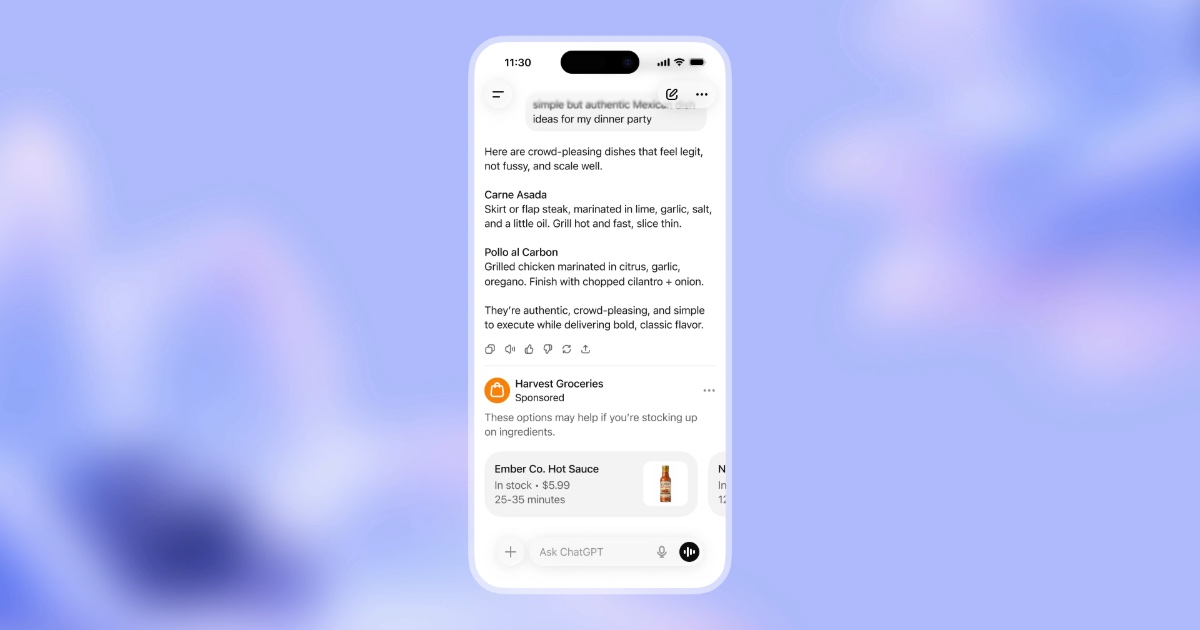
What changed this month: Paid media continued to move closer to the point of action this month, with ads appearing inside video, app ecosystems, and AI assistants, not just around search results.
OpenAI confirms testing ads inside ChatGPT
ChatGPT announced it is testing ads at the bottom of answers, shown only when a relevant sponsored product or service aligns with the conversation. Ads will be clearly labelled, explain why they’re shown, and can be dismissed. They won’t appear for under-18s or near sensitive topics.
Why it matters: This marks a major step toward monetising AI answers, something search teams have long predicted. As ads move inside conversational AI, success will depend less on keywords and more on context, relevance, and trust. How ChatGPT balances utility with commercial influence will be critical to watch over the coming months.
Google Demand Gen adds shoppable CTV formats
Google introduced Shoppable Connected TV (CTV) formats, allowing viewers to browse and buy products directly from YouTube ads on TV screens.
Why it matters: CTV is no longer just an awareness channel, it’s becoming transactional. Paid strategies now need to account for commerce-enabled video environments, where discovery, consideration, and purchase happen in a single flow.
Microsoft Advertising expands Performance Max controls
Microsoft rolled out additional controls and higher limits for Search Themes within Performance Max campaigns.
Why it matters: Greater control makes automation more usable at scale. Teams can better align machine optimisation with real business intent, rather than relying on black-box performance alone.
2026 Search Predictions
2025 was the year of monumental shift, where cracks in brands’ visibility started to show. AI Overviews diverted traffic, social platforms cemented themselves as search destinations and consumers became noticeably less patient with generic, automated content. The signals were everywhere: discovery was fragmenting, trust was shifting and the old rules of visibility needed rethinking.
2026 is where those changes take shape. AI will increasingly collapse discovery and decision-making into a single moment, earned media will become a core signal of credibility and brands will be judged less on where they rank and more on whether they’re understood and trusted across the ecosystem. At the same time, audiences will continue to reward human craft, long-form storytelling and emotionally resonant content in response to digital fatigue.
Read the full 2026 predictions here.